The exchange market in Venezuela begins a decisive week for the price of stablecoins in bolivars. With the start of a third week of auctions for $300 million aimed at private banks, the increase in currency supply is expected to alleviate upward pressure on the USDT stablecoin, whose demand has escalated in recent months. According to data shared by the economist and director of Ecoanalítico, Alejandro Grisanti, so far this year placements through this channel total 800 million dollars. Grisanti projects that, if the pace continues, the first quarter could close between 1,400 and 1,700 million dollars via financial system. These 800 million dollars, which would exceed the injection of the entire last quarter of last year, strengthen the stability of the exchange rate, since they reduce the risk of abrupt exchange rate episodesaccording to Grisanti. This flow of foreign currency in Venezuelan banks has derived from the oil agreements between Venezuela and the United States. These agreements have allowed a more regular entry of foreign currency into the economy of the Caribbean country. This, making it easier for the issuing entity to have resources to try to contain the depreciation of the bolivar through direct offer in the bank. This is important, considering that the price of USDT in Venezuela has risen 5% in a week. In this way, it goes from 518 bolivars to an average of 540 bolivars per unit in the main P2P markets. This is what it looks like in the following graph:
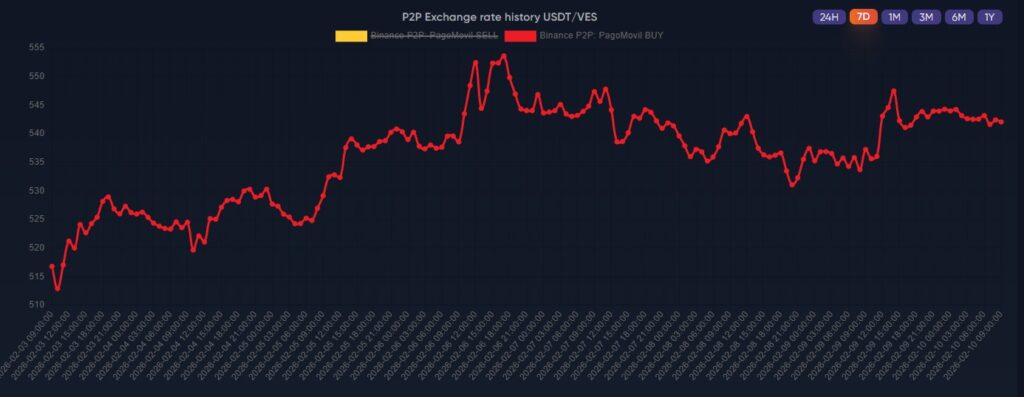 The price of USDT in Venezuela has risen this week. Source: P2P.Army. For its part, the official dollar, arbitrated by the Central Bank of Venezuela (BCV) has registered an increase of 3% in seven days. It stands at 383 bolivars, after increasing from 371 bolivars. The graph below shows it better:
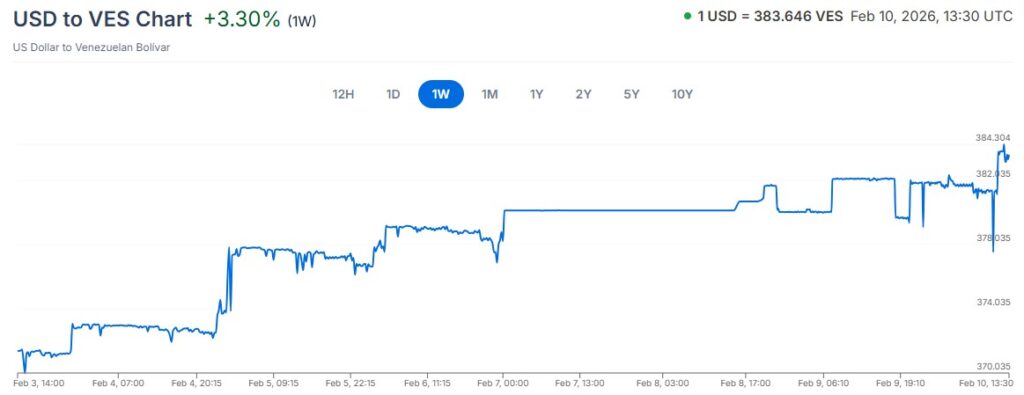 The price of the dollar arbitrated by the BCV rose 3% in a week. Source: XE.com.
Why would USDT drop in Venezuela this week?
It must be taken into account that auctions inject more dollars into the system. This, theoretically, should stabilize the market and reduce the difference between USDT and the official exchange rateby increasing the available supply. Therefore, it is foreseeable that, faced with a new wave of exchange interventions, The price of USDT in Venezuela would fall this week. However, the effectiveness of this measure depends on constant execution and that the real demand of economic agents does not exceed the auctioned amounts. Now, it must be clarified that it would be a specific price reduction, since these types of solutions are not definitive, but temporary. This has been demonstrated in previous injections of foreign currency into Venezuelan banks this year. Although there were instant reductions in the price of USDT after previous exchange interventions, these were reversed when demand exceeded the supply of dollars and consumers turned to the stablecoin to protect themselves.
This happens because not all people have access to bank auctions, since the acquisition mechanism is restricted by banking entities. However, interest in dollars in banks is growing since this way people can obtain foreign currency at a cheaper price than that governed by the secondary market. So the injection of dollars into Venezuelan banks can be understood as a “thermometer of expectations.” This is because investors are the ones who perceive these interventions. and interpret them according to their estimates. For them, if the $300 million is understood as a palliative measure, they will continue to take refuge in USDT, even if there are dollars in the bank.
An unstable economy
The rise of USDT as a safeguarding tool is evident. Eleazar Colmenares, CEO of the payment gateway CryptoBuyer, assures that almost half of operations under $10,000 with digital assets in Venezuela are carried out with stable cryptocurrencies. Indeed, for millions of Venezuelans, the digital currency issued by Tether Limited has gained space as a hedging mechanism and medium of exchange. It, due to the shortage of cash currency and banking limitations.
From digital ventures to long-established companies, They use the digital asset to maintain the value of their money and simplify payment to suppliers abroad. Additionally, USDT has served as an “oxygen valve” for Venezuelans who have endured inflation and the loss of purchasing power of the local currency, the bolivar, which is constantly depreciating against the North American currency.
As financial educator Juan José Martínez pointed out to BitcoinDynamic, “cryptocurrencies and especially stablecoins like USDT injected oxygen into the economy of many people.” Due to the above, USDT continues to be maintained as a value reference in a country that has managed to survive economic difficulties. Even becoming an important part of a society that knew how to move towards the digital economy, although out of necessity.