The bitcoin (BTC) market faces a potential key technical zone amid its current corrective phase. It is about 62,000 dollars (USD). Although this level is currently far from the current price ($89,000), it is an important level to take into account. The reason? It is the realized price of the bitcoin balance on Binance, the cryptocurrency exchange with the highest trading volume. This metric reflects the average cost of acquiring bitcoin reserves on the platform. Since the last bullish cycle culminated in 2021, This indicator has functioned as a turning point. “When the price of bitcoin remains above this level, the bullish trend continues; when it falls below, the bearish season begins,” explains analyst Burak Kesmeci. The realized price of bitcoin on Binance has acted as relevant support in correction phases in bull markets. However, the current context presents structural differences compared to the past that could lead to changes, according to the analyst. This, mainly due to the emergence of exchange-traded funds (ETFs) in the United States that attracted institutional investors.
The post-bitcoin ETF era
The digital currency has not tested this price level since the approval of the bitcoin spot ETF in the United States. That is, it has been trading above for more than two years. With the arrival of these instruments in January 2024 (pink band on the chart), “the dynamics of the market changed,” highlights Kesmeci. Before that, the realized price of the Binance reserve was around $42,000, but after the authorization of the ETFs, this level rose to $62,000.
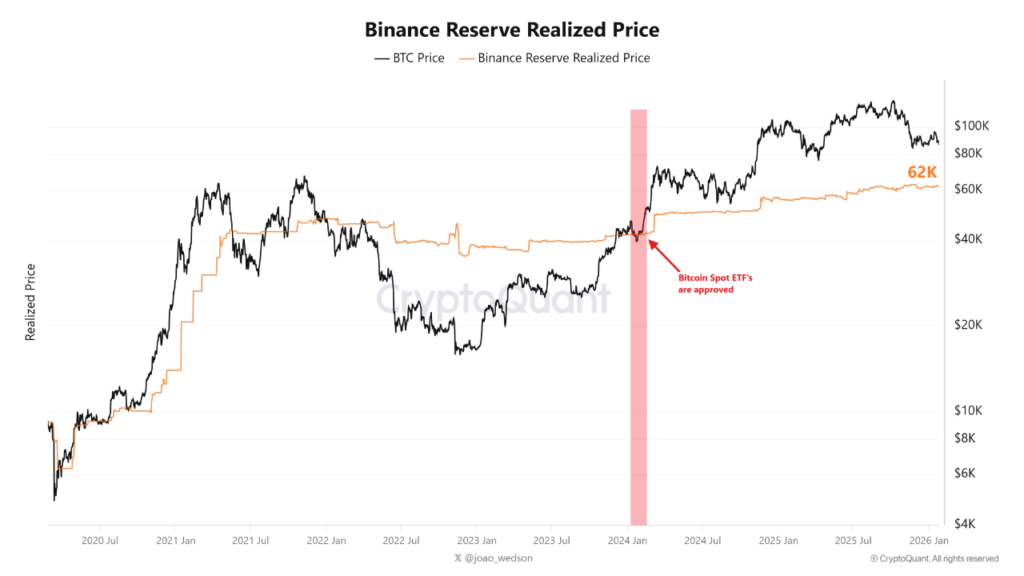 Bitcoin remains above the realized price on Binance, which stands at USD 62,000. Source: CryptoQuant. “With paradigm shifts—institutional investors, ETFs, and greater adoption—the bottom of this bearish season could be different from previous cycles,” the analyst indicates in a report on the matter. Bitcoin’s volatility decreases over time as it gains more long-term investors. In this sense, there is less selling pressure, which could mean that the currency does not have such a marked bear market. For Kesmeci, bitcoin is already in a bearish cycle from a technical perspective, although it has not fallen from the price realized on Binance. Therefore, he believes that the $62,000 level now represents “the first major test of support of the post-ETF era.” Since October 2025, when BTC marked an all-time high price of $126,000, the cryptocurrency market has seen declines. This move has reignited debate over the possibility of a new crypto winter, a period marked by contraction and lower activity in the sector.
A possible bear market underway different from previous ones
Sebastián Serrano, founder of the Argentine cryptocurrency exchange Ripio, also estimates that “the so-called bear market is already underway,” as he told BitcoinDynamic. In his opinion, bitcoin could drop to the psychological zone of $75,000 throughout 2026. The businessman considers that the current market moment is different from previous cycles, making a strong decline impossible. For the executive, the entry of institutional investors and the advance of bitcoin ETFs have contributed to making the market more structured and resilient. There is a greater participation of buyers from the traditional financial sector, he maintains. Therefore, he estimates that the recent falls were more moderate than in the past.
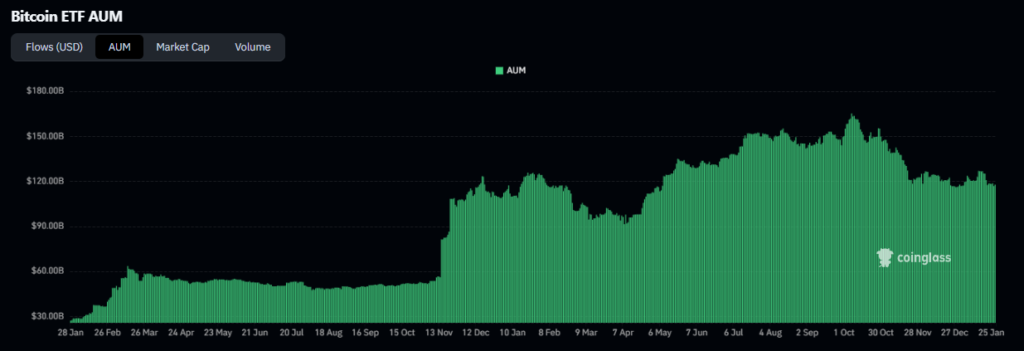 Spot bitcoin ETFs in the United States currently hold 117.6 billion assets under management (AUM). Source: Coinglass. «I wouldn’t say we’re already in the middle of winter, but we may be entering it. We may have one or two reasonable quarters before a larger correction,» Serrano said. “If winter comes, the tendency is for it to be shorter, around a year,” he added. According to Serrano, cryptocurrencies are entering a more mature phase. In practice, this means less wild price fluctuations and more focus on solutions with real use, liquidity and practical application on a daily basis. He explains that the presence of large investors helps absorb the sales movements that previously caused pronounced falls. With it, the market tends to become more stable and predictable. “In 2026, the sector should be less euphoric and more rational, with less retail participation and greater institutional adoption,” he comments. “In the long term, bitcoin continues to trend upward, supported by scarcity and its role as a protective asset.”
ETF demand as a long-term driver
The analysis of the structural impact of ETFs was also recently addressed by Matt Hougan, CEO of Bitwise, the issuing firm of one of these products in the United States. For the executive, recent rise in gold offers clear guidance about what could happen to bitcoin if institutional demand is sustained over time. According to Hougan, central bank demand for gold began to accelerate in 2022, after the United States confiscated Russian Treasury deposits. “Annual purchases went from about 500 tons to about 1,000 tons and have remained at those levels since then,” he explained. Even so, the impact on the price was progressive. Gold advanced about 2% in 2022, 13% in 2023 and 27% in 2024. “It wasn’t until 2025 that prices skyrocketed,” Hougan said. He explains that, during the first years, this additional demand was absorbed by investors willing to sell their reserves. “Over time, sellers ran out of ammunition, and as demand persisted, prices rose sharply.” For the CEO of Bitwise, the bitcoin market is going through a comparable dynamic, which might not mean the start of a bear market. Since the launch of spot ETFs in January 2024, these products have been purchasing over 100% of the new BTC supply. However, the price has not yet reflected this imbalance. “This happens because the existing holders have been willing to sell,” he said. Hougan concluded that the deciding factor will be the persistence of that demand. “If demand for ETFs continues over the long term—and I think it will—over time those sellers will also run out of ammunition,” he said. Consequently, in such a scenario, “the price of bitcoin will skyrocket,” he believes.