Armstrong stated that BTC is “the largest accountability mechanism for spending.” The Frenchman trusts more in the “independence” of the banks and not in the “private issuers” of BTC. During a panel on the future of tokenization at the World Economic Forum in Davos this Wednesday, Brian Armstrong, CEO of Coinbase; and François-Valéry de Gaulleux, governor of the Central Bank of France, led a debate on the viability of Bitcoin as a new global monetary system. Armstrong argued that the digital currency created by Satoshi Nakamoto represents a return to «sound money» in the face of central bank issuance policies. The executive of the largest cryptocurrency exchange platform in the United States stated that, after the abandonment of the gold standard in 1971, democracies have had difficulty balancing their budgets. This, systematically resorting to the deficit and causing inflation in fiat currencies. In this context, Armstrong proposed the concept of a “Bitcoin standard.” «I think fiat currencies will be around for a long time, but we are also seeing the birth of a new monetary system that I would call the ‘Bitcoin standard’ rather than the gold standard,» Armstrong noted. According to the manager, the digital currency works as a check and balance system against deficit spending, since, unlike the traditional banking system, bitcoin does not have a money printer and its supply is fixed.
«I trust more in independent central banks»
Armstrong’s position was met with skepticism by François-Valéry de Gaulleux. The governor of the Bank of France and member of the Governing Council of the European Central Bank (ECB) defended that monetary sovereignty is a key function of democracy that must remain under public control. De Gaulleux expressed his preference for the current institutional system. «The guarantee of trust is independence on the part of the central bank. “We have a fundamental mandate and we are comfortable with it,” he said. For this reason, he assures that he trusts more in independent central banks with a democratic mandate than in «private issuers» of Bitcoin.
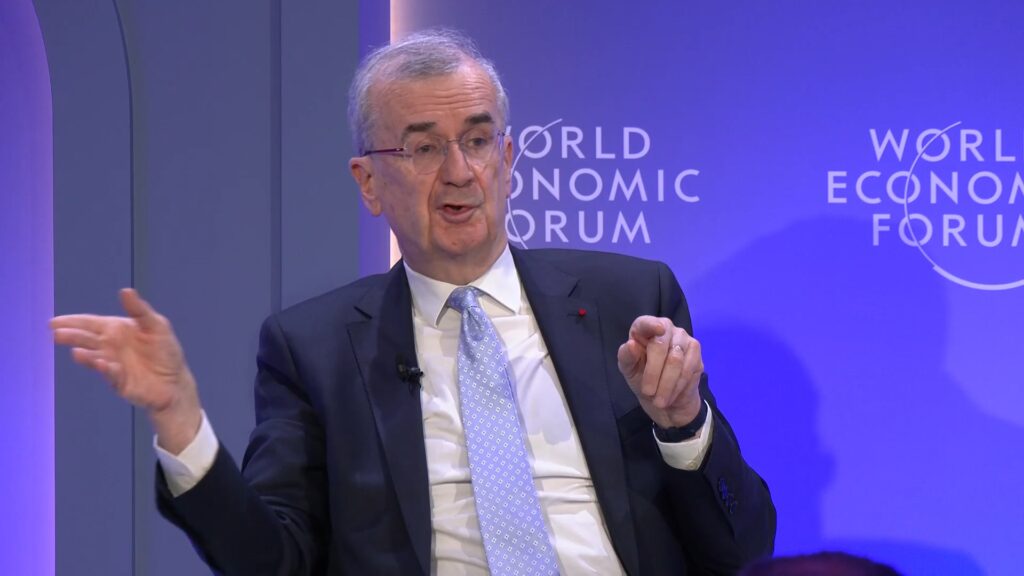 De Gaulleux said he trusted independent central banks more than “private issuers” of Bitcoin. Source: WEF. Faced with this statement, Armstrong corrected the official pointing out the technical nature of the asset:
Bitcoin is a decentralized protocol. It doesn’t actually have an issuer and it doesn’t have a money printer. So in the sense that central banks have independence, Bitcoin is even more independent. There is no country, company or individual that controls it in the world. Brian Armstrong, CEO of Coinbase.
For him, this characteristic makes the digital currency «the largest accountability mechanism for deficit spending» at a global level.
The role of tokenization and stablecoins
The debate also addressed the technological infrastructure that supports digital assets. Brad Garlinghouse, CEO of Ripple, who also participated in the meeting, stated that stablecoins are the first great example of success of tokenization. To this end, he cited the transaction volume reached by these vehicles in 2025, of 33 billion dollars. However, Garlinghouse put forward a more integrative vision than Armstrong. He suggested a “marriage” between traditional and decentralized finance. The executive recalled that governments will hardly relinquish control of their monetary supply, which is why The focus should be on building bridges between both worlds.
For his part, de Gaulleux warned about the risks of fragmentation and lack of regulation. Although he mentioned progress in that regard, such as the MiCA regulatory frameworks in the eurozone and the GENIUS Act in the United States. The French banker expressed his fear of a modern version of Gresham’s Law. According to her, «bad money» displaces «good» if there are no security guarantees for users.
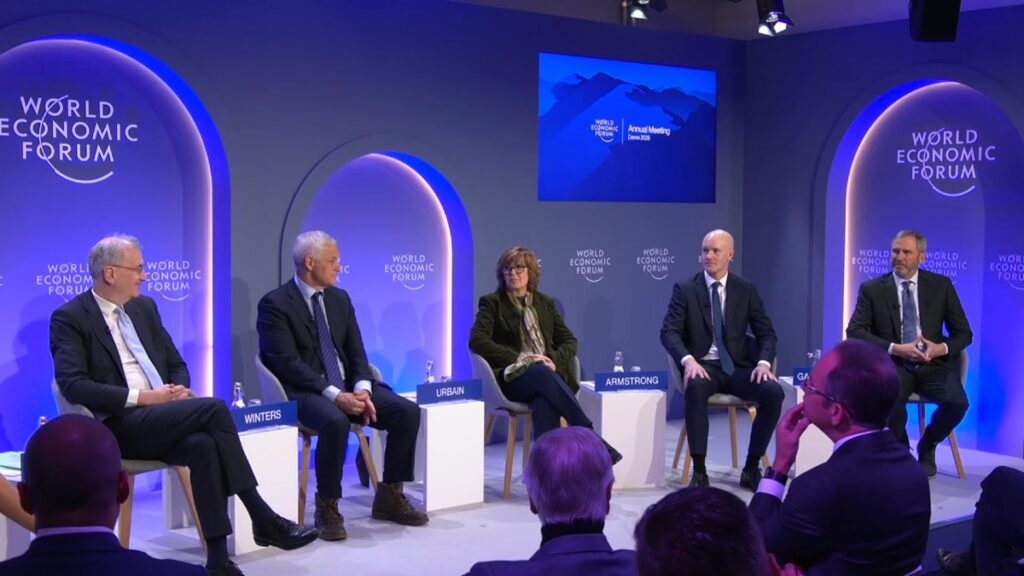 The debate on the finances of the future was present in Davos. Source: WEF. Armstrong, for his part, concluded that competition between systems is healthy for the global economy. According to their analysis, in countries with high inflation such as Argentina or Türkiye, the population naturally seeks to take refuge in assets that better preserve their value. «If fiat currencies can maintain trust and not have the ‘money printer’ devaluing everyone, they will survive,» he said. As institutional adoption of Bitcoin technology advances, the debate in Davos makes clear that the tension between traditional monetary policy and scheduled issuance protocols will continue to be a central point on the international financial agenda of the coming years.