One developer claimed to have created a working clone of MetaMask in just 20 minutes. Without touching a single line of code, users are launching digital solutions that no one asked for. NFTs (non-fungible tokens) emerged as a fever driven by accessibility: anyone could launch a collection and dream of million-dollar investments. However, for many, these were assets with no intrinsic value. Today, a new trend claims that space of excessive “hype”: vibe coding. With the maturation of generative AI, the focus has shifted to programming. Now, advanced tools They allow complex interfaces and functions to be replicated with simple instructions. A notable example was that of Abbas Khan, a developer at the Ethereum Foundation, who demonstrated how to create a functional clone of the MetaMask wallet using only four prompts in the Claude 3.5 Sonnet model, a milestone reported by BitcoinDynamic. This means that, in theory, any user could launch their own cryptocurrency wallet without understanding what’s going on under the hood. This extreme democratization is creating a saturation of products that, like many 2021 NFT collections, lack real demand. The parallel is inevitable: from digital works that lost 99% of their value — like Logan Paul’s famous NFT, which went from being worth USD 623,000 to just USD 10— even AI-generated applications that are forgotten shortly after being published.
 In 2021 Logan Paul purchased this NFT for 193 ETH. Source: CoinMarketCap.
Where does the term vibe coding come from?
The term comes from the vision of Andrej Karpathyformer head of AI at Tesla. In a Twitter post from February 2025, he describes a process where the human only transmits the «vibe» or intent of the software to the machine. In this model, the user acts as an orchestra conductor for Artificial Intelligence. The AI interprets the instructions in natural language and generates the entire technical structure without human intervention. This trend eliminates the need to learn complex programming languages like Python or JavaScript. The focus shifts entirely to creativity and the ability to give precise instructions or prompts. By 2021, at the height of the NFT boom, platforms like OpenSea made it easy to create and sell an NFT without moving a single line of code.
Solutions that no one asked for
The ease of creating clones generates an excess of tools that saturate the digital ecosystem. Users launch cryptocurrency wallets and financial apps without understanding their inner workings. A study of GitHub indicates that AI-assisted repositories grew by 40% recently. However, most of these projects lack frequent updates and die soon after their release.
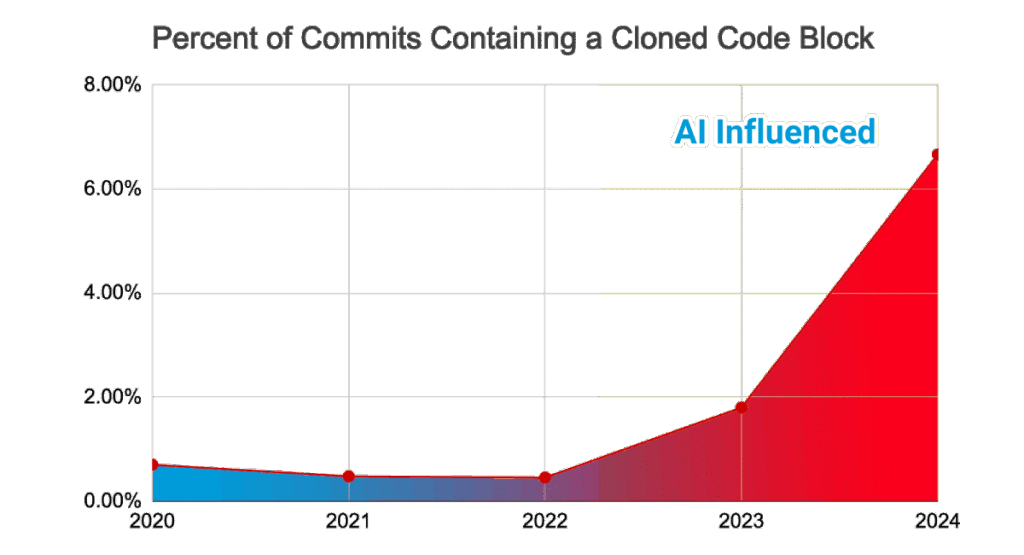 Since the advent of AI, the amount of code copied on Github has quadrupled. Source: Gitclear. This trend shows that there are more people creating solutions. It is common to see people create copies of Uber, but is it really what the market needs? The trend seems to be just to copy the most successful app in terms of functionality and interfaces, leaving marketing and security aside.
The 80/20 problem
Forbes explains that AI easily solves the first 80% of an application. This percentage includes only the visual interface and the initial basic functions. The remaining 20% represents the most difficult and expensive work for any developer. This final stage covers the security, scalability and complex bug fixesvital for the continuity of a project. Many vibe coding projects fail when trying to bridge this technical gap. Creators abandon their apps when AI fails to solve deep structural problems. The cost of maintaining these tools grows exponentially after the initial release. Without technical knowledge, users cannot manage the junk software that generates vibes.
We are still in early stages
 Arturo Elías Ayub is the son-in-law of Carlos Slim, the 9th richest man in the world. Source: Wikipedia. Investors like Arturo Elías Ayub, famous for the show Shark Tank, have made statements that they stay away from these flash investments, where they promise to create applications in record time, due to the security problems they may face. Although the term “vibe coding” was coined a year ago, it still seems that we are in the beginning, there is still no wave of investment reaching these “solutions”, although, due to how practical it becomes, it is possible to begin to see advertising campaigns for applications that solve certain specific problems, or rather, they claim to solve, however, they are nothing more than pseudo-developers creating solutions to attract investment.