The platforms ether.fi and Hinkal announced a collaboration that seeks to improve user privacy when spending crypto assets using a credit card linked to the Ethereum network. On ether.fi, a decentralized finance (DeFi) protocol, users can stake, borrow, and offer liquidity. Furthermore, it offers Ether.fi Cash, a self-custody Visa card (virtual and physical).
 Ether.fi offers its users four different models of Visa credit cards. Source: ether.fi. Hinkal, for its part, is an on-chain privacy protocol that uses smart contracts and cryptographic proofs, such as zero-knowledge (ZK), to allow confidential transactions on public networks. Additionally, Hinkal works as a self-custody hot wallet that hides details such as amounts and origins without revealing the identity of the user. Both companies announced the integration on December 12, through their official accounts on X.
Ether.fi offers a card, but without on-chain privacy
To use the ether.fi card, the user must deposit funds into a member vault. These vaults are smart contracts that store funds intended to support card payments. They can operate on Ethereum or second layer (L2) networks, such as Scroll. The “problem” is that Ethereum is a public network. Therefore, anyone can observe in browsers the transfers from a personal wallet to the vault that funds the card. This link exposes the so-called financial graph, that is, the relationship between balance sheets, fund origins and historical movements. The integration with Hinkal aims to resolve that point. Hinkal works as a shielded wallet, which uses ZK to hide amounts and relationships between transactions.
How does Hinkal bring privacy to the use of the ether.fi Ethereum card?
With this collaboration, the user first deposits funds in the “shielded pool” section of Hinkal, a private fund. Although that initial deposit is visible, the trail is interrupted there.
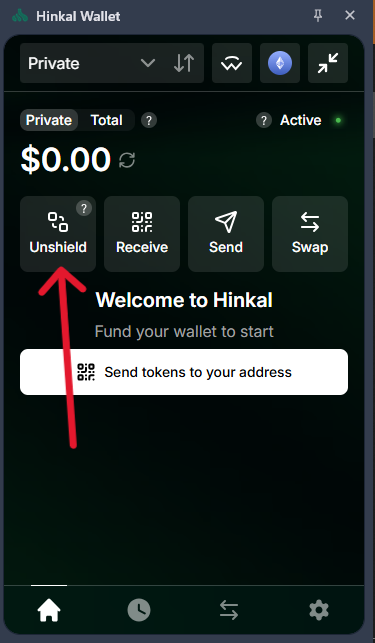 Hinkal works as an online wallet with desktop extensions. Source: Hinkal. The user then unshields only the necessary amount to an intermediate public address and, from there, transfers the funds to the ether.fi vault. The result is that There is no direct on-chain link between the wallet user’s main and card. Thus, in Ethereum no direct link is registered between the user’s main wallet (where they can hold funds in staking or DeFi strategies) and the account associated with the card. By interposing that layer of privacy, the integration reduces the risk that on-chain analysts or third parties reconstruct a digital path to a user’s wealth, strategies or economic behavior.
More privacy does not equal anonymity
Now, this protection operates within the scope of the network. But, on the other hand, ether.fi requires KYC (know your customer) to use the platform and issue the carda requirement derived from AML (anti-money laundering) regulations and Visa policies. This implies that the user’s identity is linked to the account off-chain, that is, outside the public Ethereum registry. In that sense, collaboration does not offer anonymity, but rather better privacy management on chain. The model allows daily movements not to reveal the size or origin of the user’s capital to external observers.