Something is moving in Japan. And this is no small matter: it is the kind of shock that can disrupt financial markets in the rest of the world. It’s just that Japan, which has historically maintained low interest rates, could change the script before the end of 2025. That shift could trigger a domino effect far beyond Tokyo. For this reason, financial markets, including bitcoin (BTC) and cryptocurrencies, closely follow the development of events. The first thing to note is that the last time the Bank of Japan (BoJ) raised interest rates was in January 2025, when he took them from 0.25% to 0.50%, a level not seen for 17 years. Since then, the rate has been set at 0.50 points.”
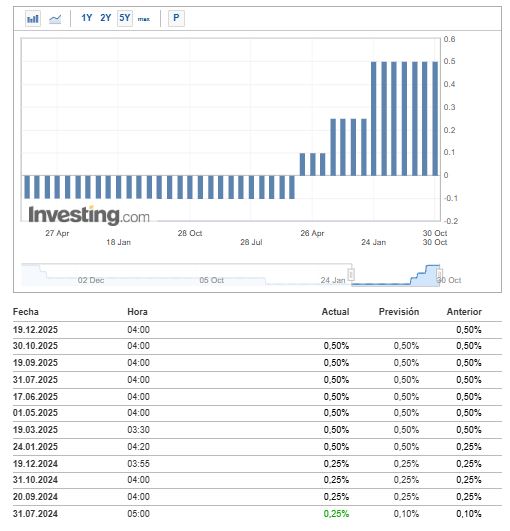
Japan’s interest rate is 0.5%. Source: Investing. After two decades with interest rates at historically low levels—even in negative territory— The BoJ now faces a much more demanding scenario.
Inflation, which for years remained docile, began to pick up speed and is now comfortably exceeding the central bank’s 2% target. A key indicator is underlying inflation, which rose to 3%, its highest record in more than three years, and adds pressure for the monetary authority to continue tightening its policy. In this framework, the climate within the BoJ is beginning to show clearer signs. The governor, Kazuo Ueda, assured this Monday that sees less uncertainty around US tariffsin addition to a salary rebound and solid corporate profits. For him, these conditions open the door to a new monetary adjustment, which further raises expectations of a rate increase this month. “We intend to make an appropriate decision on whether we will raise interest rates further,” he said. At the same time, he noted: “A late adjustment to the degree of monetary flexibility could cause confusion.” The decision will be known on December 19.
Markets react downward
Ueda’s statements did not go unnoticed. As soon as they were made public, the Nikkei reacted with a drop of close to 2%, while Japan’s 10-year government bond yield jumps to 1.875%the highest level in the last 18 years, as seen in the following graph:

Japan 10-year bond yield. Source: TradingView. The financial markets reacted negatively to the panorama coming from Japan. The Dow Jones lost 0.62% (-295.65 points) to 47,420.77 units, while the S&P 500 fell 0.34% (-23.22 points) to close at 6,825.87. The Nasdaq did not escape the correction either and fell 0.29% (-68.69 points), to 23,297.00. The impact was also felt in the digital asset market. Bitcoin, influenced by this and other factors (such as the statements of the Strategy CEO and doubts about the solvency of USDT) fell below $90,000, while Most of the cryptocurrencies that make up the top 100 by market capitalization were painted red.
This negative reaction is related to the carry trade. Albert Edwards, financial markets analyst, explains this phenomenon: «If higher Japanese bank yields entice Japanese investors to return home, the carry trade reversal could cause a strong sucking sound in US financial assets. Therefore, I would consider trying to understand and follow the rising long end of the Japanese market as the most important thing for investors at the moment.» As BitcoinDynamic explained, the carry trade—sometimes called “financial bicycle”—consists of taking yen at a very low cost and placing them in assets from other countries that offer higher returns. Is a mechanism to take advantage of the difference between rates to make a profit. But what happens if that differential begins to narrow? The incentives to maintain these positions are diluted and there may be an outflow of capital from the United States and other markets. This creates downward pressure on bonds and stocks. In that scenario, the Bank of Japan’s movements could end up transmitting turbulence to the rest of the global financial system.
Why does Japan’s interest rate affect bitcoin?
Bitcoin is often presented as a type of “digital gold,” but in times of global tension the market still treats it more as a risky asset than a safe haven.
Therefore, given the nervousness generated by Japan, its price accompanied the fall of the stock markets. Gold, for its part, once again approached historic highs. Uncertainty caused widespread selling and BTC was not left out, as many investors sought liquidity and less exposure to risk.
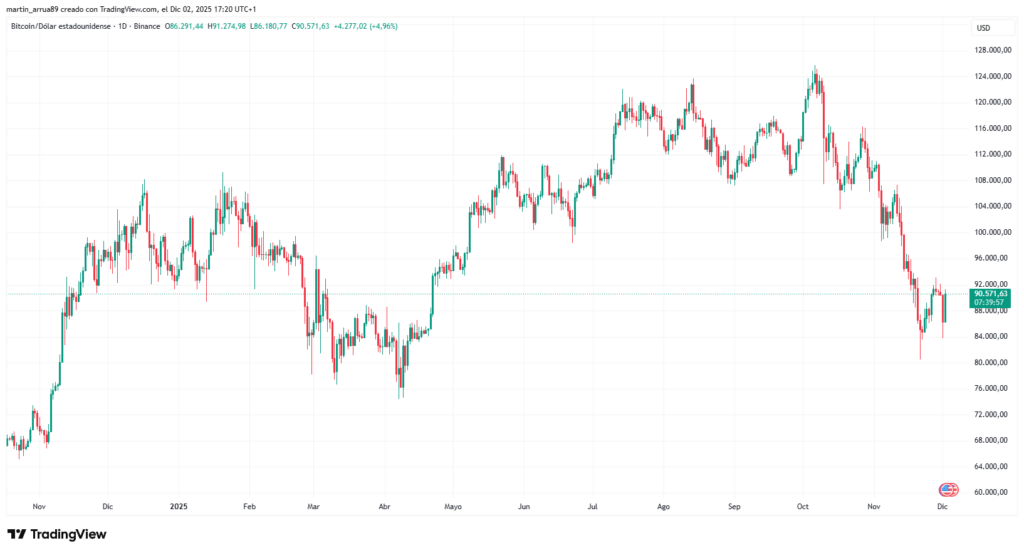
BTC price in the last 12 months. Source: TradingView. However, it should also be mentioned that for those looking at the price in the medium or long term, these drops can represent opportunities to buy at lower prices. The currency created by Satoshi Nakamoto has shown resilience and growing institutional support. This keeps corrections attractive times to accumulate.