If someone is asked what is needed to build a building, it is most likely that in your response you will mention the albañil, concrete, brick and cement words. For decades (and centuries) this is how it has worked on the work, and even today most housing follow this traditional construction model. But in recent years an alternative has emerged that, despite being still a minority in Spain, has managed to make a place in the market. It is the modular construction, a type of architecture that uses prefabricated modules to create complete structures: from individual villas to blocks of floors, schools, hospitals … just 2% of the homes that are delivered in Spain follow this system in which some are enough A few months to lift a building. But some studies expect that, from here to 2030, the figure could reach 10%. An still far away from what happens in Sweden or Netherlands, where up to 50% of all its properties are built according to this industrial pattern. In fact, the sector prefers to talk about “industrialized construction”, because it implies introducing mechanized processes throughout the entire development of the work. “The big difference is that the entire house is carried out under the roof of a ship in a polygon, whereby production is faster and everything is under control. When all ready modules are already had when they move to the plot, ”explains the director of the National Congress of Advanced Architecture and Construction 4.0, Ignasi Pérez. It is already outdoors and in the chosen environment when the work is finished and connected to sanitation and supply networks.
Beyond the price
The defenders of this business model highlight its advantages over traditional architecture. Save time and costs; Quality and safety standards are excellent; The manufacturing process is more respectful of the environment because less waste is generated, and the versatility of the modules favors that they can be used in many residential projects. When someone wants a home, Pérez says, he knows that up to three years they will not give him the keys. “That discourages anyone. On the other hand, industrialized construction is closer to what the 21st century society demands because it is able to produce in a very short time, ”he argues. Another point in his favor is that he adjusts to the money budgeted in the contract, which does not happen with most traditional works. “It is a way of understanding construction from a totally disruptive point of view. Time and budget are important, but the quality and efficiency of these homes do not have a paragon with any other types of buildings, ”insists this expert. More information about the Superior Council of the Colleges of Architects of Spain recognize that the fact of power Incorporating these modular constructions various solutions that are controlled from the factory is reflected in the execution of the work. They also improve work safety conditions, when the activity is carried out in a closed environment, under ceiling. However, the use of the materials used in buildings is regulated from the Technical Code of the Building and through several standards “which are applicable for both traditional and modular construction,” recalls its general secretary, Laureano Matas. In his opinion, rather than growing demand for these houses, what has increased is the supply of this type of housing, which are presented as a useful option due to certain circumstances.Jarama (Getty Images) holds Matas that, before deciding on a project of these characteristics, it is convenient to assess whether it is worth incorporating prefabricated pieces and modules not only to save money, but from a technical point of view. Its integration should also be taken into account as an architectural solution in relation to its built environment. «If we think of prefabricated homes, it seems that society has them associated with something that is temporary or the emergency situations,» says Matas.Coincide with this idea the head of the Technical Cabinet of the General Council of the Technical Architecture of Spain (CGATE) , Juan López-Asiain. “Many people twist when he hears the word prefabricated or industrialized, and it is an error. These constructions have even greater durability, because it is much easier to put a tile tile on a ship with a machine that helps you, than doing it by hand in an outdoor room with rain or cold, ”he says.
Claim to attract talent
One of the great challenges of traditional construction is precisely the low availability of labor. The reality is that it is an aged sector that few young people access, which is causing the disappearance of a multitude of companies due to lack of generational relief. The same does not happen, on the other hand, in the field of industrialized construction, where it is easier to recruit workers. «The schedules are less slaves, work is covered in the ship, the environment is safer, and that translates into a greater capacity to get employees,» López-Asiain continues. It is no accident that, in the coming years, some projections plan These works reduce the execution deadlines, the profitability of the investment is triggered. The internal return rate (IRR) of these projects is four to five times higher compared to traditional methods, they point out from the Spanish Industrialized Construction Association (AECI). That is why it is a strategic and profitable alternative to the architecture of a lifetime. More information, it can be an opportunity to attract female talent to a sector in which women barely surround 10%. These circumstances are especially valuable at a key moment for the scope of construction. The Bank of Spain estimates that the country needs 600,000 new homes until 2025 to balance the real estate market, an unassumable amount «because there are no people,» López-Asiain slides. Industrialized construction contributes to alleviating this situation, and more and more companies bet For this business model. “You work as in a assembly chain, at all times you know perfectly how far you can go and how much you can produce. This makes the process very efficient and that companies do not venture to anything they cannot do, ”he says at this point Ignasi Pérez. In the longest term, the advance of industrialized construction will require a transformation of the sector. «Many trades will adapt to more demanding and precise construction systems,» corroborates the Laureano Matas architect. The reality is that today there are many firms that offer quality solutions based on modular construction. This is the case of Casas Inhaus, a Valencian company specialized in the design and execution of customizable and high -end modular housing. The use of standardized processes and series manufacturing allows them to deliver their orders in just five months. As the foundation and preparation of the land, while shaping the house in the ship, it is possible to meet the deadlines.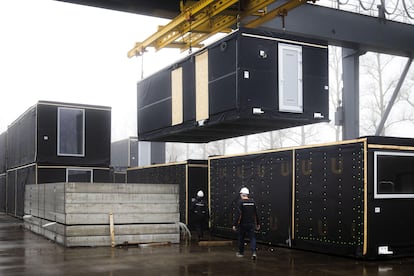 ANP (Alamy / Cordon Press) In its facilities all components are assembled, including structure, facilities and finishes. Also there are the appliances, the cabinets and the bathrooms, fully equipped. With 95% of the work already finished, the last step arrives. In a single day, the modules are transported and implemented in the plot, where the final connections are completed. “People begin to assess that there are alternatives to traditional construction. It is essential to continue educating the public about the benefits of modularity and industrialization, and end the false myths that accompany this type of housing, ”says those responsible for Casas Inhaus.
Quita and Pon buildings
Another of the profits of the modular construction is the possibility of creating relocable buildings that can be reused when necessary, and transported in a very short time to places where a special need is necessary to cover. It occurs, for example, in cases of emergency and natural catastrophes, or when exceptional events are developed such as Olympic Games, and at the end, we want to recover the environment that already existed before. In a few weeks, this versatile solution allows you to lift schools, hospitals, offices and almost whole cities out of nowhere. This implies a different way of projecting at the architectural and structural level. “They are facilities that are mounted as the pieces of a mecan. They plug and unplug like a train car in the convoy, «explains Ignasi Pérez.» But that temporality clashes with the need for roots of people with their built environment and their homes, «says Laureano Matas. Because one thing is the theory, and a very different practice. Matas insists that cities, towns and neighborhoods have urban ordinances and characteristics associated with the place – like the land and the weather, among others – that complicate to relocate a building that fit well in another previous location. “Usually, simple and repetitive solutions do not solve complex problems. They simply disguise them, ”laments this architect. That is why it is essential new. However, from the General Council of the Technical Architecture of Spain (CGATE) they warn of another problem associated with these relocable modules: when they are disassembled, they are usually spoiled, because their use and the passage of time have an impact on the state of the installation. «From a point of view of quality and costs, if you add the money that disassemble, transport, assembly and repair, you see that the price difference is not so important,» says Juan López-Asiain. Many of these structures, in addition, end up in fields or on land located outdoors where they still deteriorate more.
A strategic plan for this business
The Government has announced this year a battery of 12 new measures so that the population's access to housing is more affordable. One of them is the creation of a strategic project for the recovery and economic transformation (PERTE) of homes, aimed at promoting the innovation and modernization of the industrialized and modular construction sector to build houses in less time and more affordable. It will start in Valencia: with a first initial item of 100 million euros, the objective is to help reconstruct the economic fabric affected by the DANA and generate added value to the entire country.
“The belong will make Spain rise in position in the use and application of industrialized construction. It is a great step to approach the way in which it is built in the rest of Europe and in part of the world, ”says the director of the National Congress of Advanced Architecture and Construction 4.0, Ignasi Pérez.
The sector agrees that modular homes could benefit from an increase in demand, since the executive's plan contemplates a financing line and aid to access them. In any case, they remember in the Superior Council of the Colleges of Architects of Spain, industrialization is «an instrument, a tool» to guarantee an excellent architecture that must be «always sensitive» to the specific needs of the people who are going to inhabit The houses, as well as the environment and the cultural identities of the peoples.