In one of the weeks with the greatest on-chain activity in recent years, more than 8% of the total bitcoin (BTC) in circulation has changed hands. According to data shared by Joe Burnett, director of Bitcoin strategy at Semler Scientific, a movement of this magnitude had only been observed on two previous occasions. It was in March 2020, when the price fell to USD 5,000, and in December 2018, when the digital currency was around USD 3,500. The current increase in transferred volume coincided with the drop in the price of bitcoin towards the USD 80,000 area. Therefore, it becomes one of the most relevant on-chain events of the current cycle.
The Glassnode chart below shows that BTC’s recent change of hands It is at the level of the great historical setbackswhich has sparked debate among analysts.
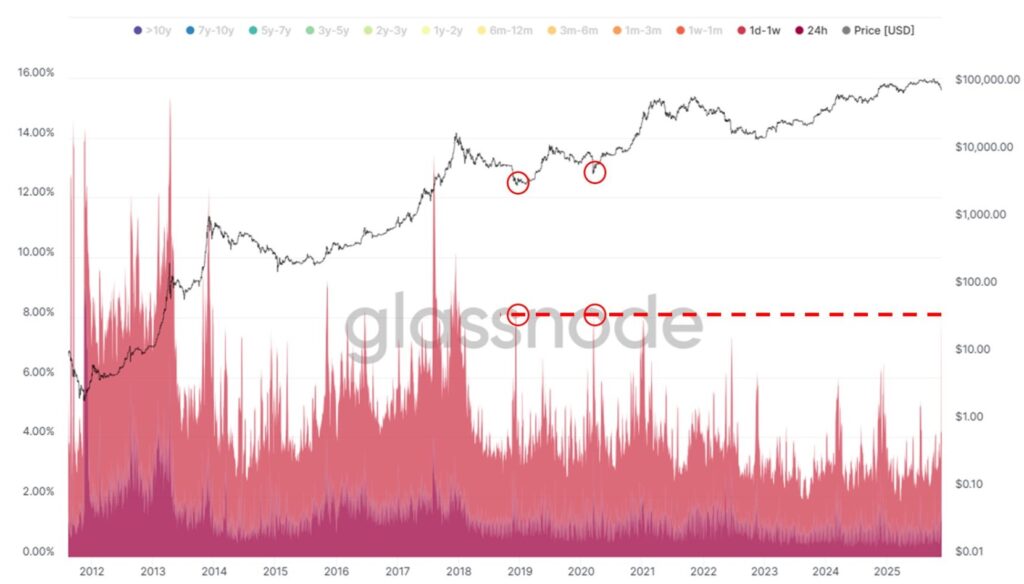
The intensity of the recent movement is at the level of BTC’s major historical pullbacks. Source: Glassnode.
bitcoin comes out from Coinbase
Part of bitcoin changing hands would be related to the massive outflow of BTC from the Coinbase exchange. This was indicated by Darkfost, an analyst at the CryptoQuant firm. The following graph shared by the analyst reflects the bitcoin reserves of the largest exchange in the United States. It shows an abrupt decrease during November, suggesting that a significant portion of the supply was mobilized in a short period of time.
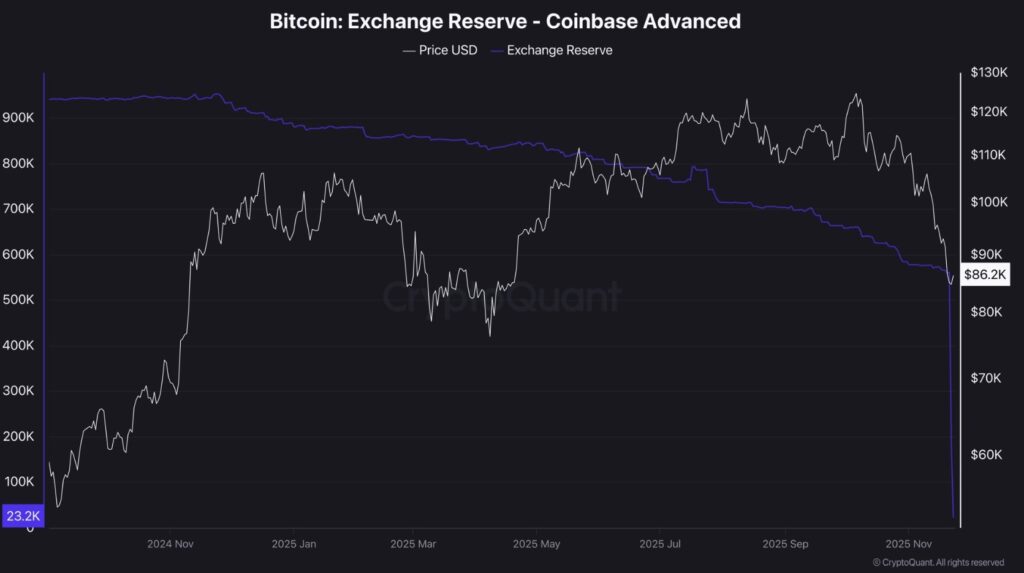
Coinbase has exited large amounts of BTC in recent days. Source: CryptoQuant. An exit of bitcoin from exchanges may indicate that there is a desire to maintain the investment for the long term, which constitutes a bullish signal for the price of the digital currency.
Old bitcoiners sell their coins
Furthermore, this behavior coincides with recent trends observed by BitcoinDynamic, where a transfer of coins has been recorded from old addresses—belonging to the so-called OG bitcoiners—to new investors. The OG bitcoiners are the people who participated in the Bitcoin protocol from its early years. That is, from approximately 2009 to 2013. However, specialists warn that these movements do not necessarily imply sales. In some cases they could simply correspond to internal reorganizations of addresses by the same entity.
Willy Woo, market analyst, has explained that events of this type can be interpreted as «capital turnover» processes. In these, the ownership of digital assets is redistributed between different investor profiles. If that were the case, the current movement could reflect a structural rearrangement rather than a sign of capitulation.