Although some companies are trading below their mNAV, there is not much forced selling. If this trend continues, it will be positive for the price of bitcoin. Companies are withdrawing bitcoin (BTC) from the market at a rate that no longer goes unnoticed. Every month, about 43,000 BTC on average disappear from the liquid supply to become trapped in corporate treasuries, a process that is seen as a true “black hole” for the availability of the digital currency. These currencies are “absorbed” by the corporate black hole and rarely leave there since they are long-term investments. Between July 15, 2025 and January 11, 2026, bitcoin-based corporate treasuries of Public and private companies have grown from 854,000 BTC to 1,110,000 million BTC. This represents an increase of 260,000 BTC, highlighting the continued expansion of corporate balance sheet exposure to bitcoin. The structure of this accumulation is visualized in the following chart, as an upward trend that has not found a ceiling. The slope at the top of the graph is constantly positive, validating the figure of a growth of 43,000 BTC per month, on average.
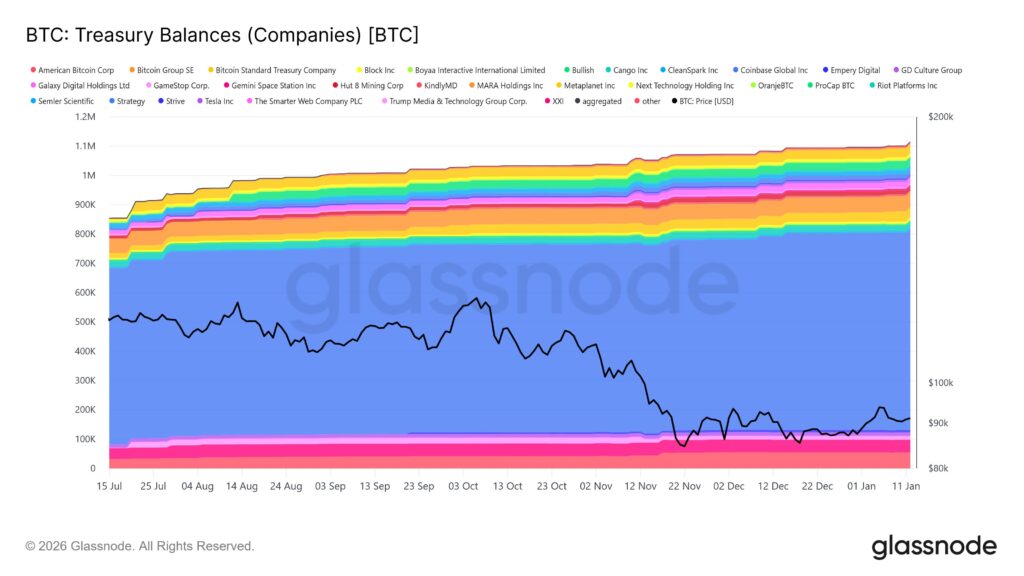 The accumulation of bitcoin by companies continues to increase. Source: Glassnode. This indicates that, Regardless of price volatility, companies have been in an aggressive accumulation phase. The largest stripe (blue) corresponds to Strategy, a company led by Michael Saylor, which is the largest by far. This occupies most of the reserve area, since it is the publicly traded company with the most BTC, adding a total of 687,410 BTC. His most recent purchase was 13,627 BTC, as Saylor announced last Monday, January 12.
Resilience in the face of market volatility
The corporate sector seems to show a firm hand in the face of bitcoin price fluctuations. All this happens while the price of bitcoin had a significant drop between October and November, falling towards the area close to $80,000; However, corporate holdings did not decline. In fact, they continued to rise. This behavior suggests that corporations are using price drops to accumulate more, viewing bitcoin as a long-term reserve asset rather than a speculative asset short term.
Challenges in financial valuation
Despite optimism regarding the volume of accumulation, there are financial metrics that suggest caution. Some companies trade below the financial metric of market net asset value (mNAV), which compares enterprise value to bitcoin holdingsbut, in any case, not many forced sales are observed. A mNAV greater than 1 allows shares to be issued to accumulate more digital assets; below, this capacity vanishes. own Strategy is going through such a situation with a mNAV of 0.76meaning that the market is valuing the entire company, including its software business, brand, management team and debt, for less than what its bitcoin reserves alone are worth. As BitcoinDynamic reported, dozens of smaller companies with less access to capital replicated the model by converting cash into bitcoin.
Bitcoin absorption and price prospects
If this trend of corporate bitcoin purchases continues, will continue to positively influence the price of BTC due to the drastic reduction in available supply. As they are withdrawn to institutional custody wallets with long-term investment horizons, sales liquidity decreases, which—in the face of sustained demand—presses the value upwards. However, the risk of a domino effect remains. If even the largest company in the sector fails to maintain a premium on its reserves, the others could face forced sales or a general crisis of confidence in the narrative of corporate BTC adoption. The future of the market will depend on whether these treasuries can sustain their positions and how the mNAV evolves in the coming weeks or months.