The end of the 4-year cycle and new ETF approvals are among the forecasts. “Positive trends in cryptocurrencies are too strong,” says Bitwise. The investment management firm, Bitwise Asset Management, has published its predictions for the bitcoin (BTC) and cryptocurrency sector for the year 2026. Although bitcoin has historically followed four-year cycles that would suggest a period of decline, the firm maintains that current trends in institutional adoption and regulatory clarity They are «too strong» to be contained.
According to Matt Hougan, the company’s chief investment officer, the market will enter a maturation phase that will challenge previous patterns. These are Bitwise Asset Management’s 10 predictions for the bitcoin ecosystem in 2026:
1. The end of the four-year cycle and new all-time highs
Bitcoin has traditionally operated in cycles linked to halving, with three years of rise followed by one of sharp decline. Under that logic, next year should be bearish. This configuration is better seen in the following graph which shows the price of bitcoin and the halvings already developed.
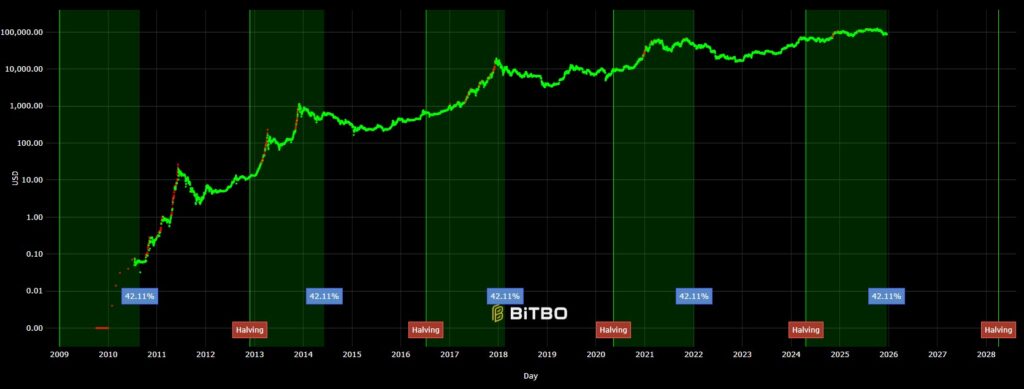 The price of bitcoin has tended to operate on four-year cycles. Source: BitBo. However, Bitwise predicts that 2026 will be the year this norm is broken. The firm argues that «the forces that previously drove four-year cycles are significantly weaker than in the past.» In this regard, they point out: «we hope that the combination of these factors will push bitcoin to new all-time highs, relegating the four-year cycle to the dustbin of history.»
2. Bitcoin will exhibit lower volatility than Nvidia
One of the recurring criticisms of bitcoin is its volatility. However, Bitwise projects that “bitcoin will be less volatile than one of the most popular stocks on the market: Nvidia.” This phenomenon responds to a maturation process. As they see it, «this change reflects the fundamental reduction in the risk of bitcoin as an investment and the diversification of its investor base thanks to traditional investment vehicles such as ETFs.»
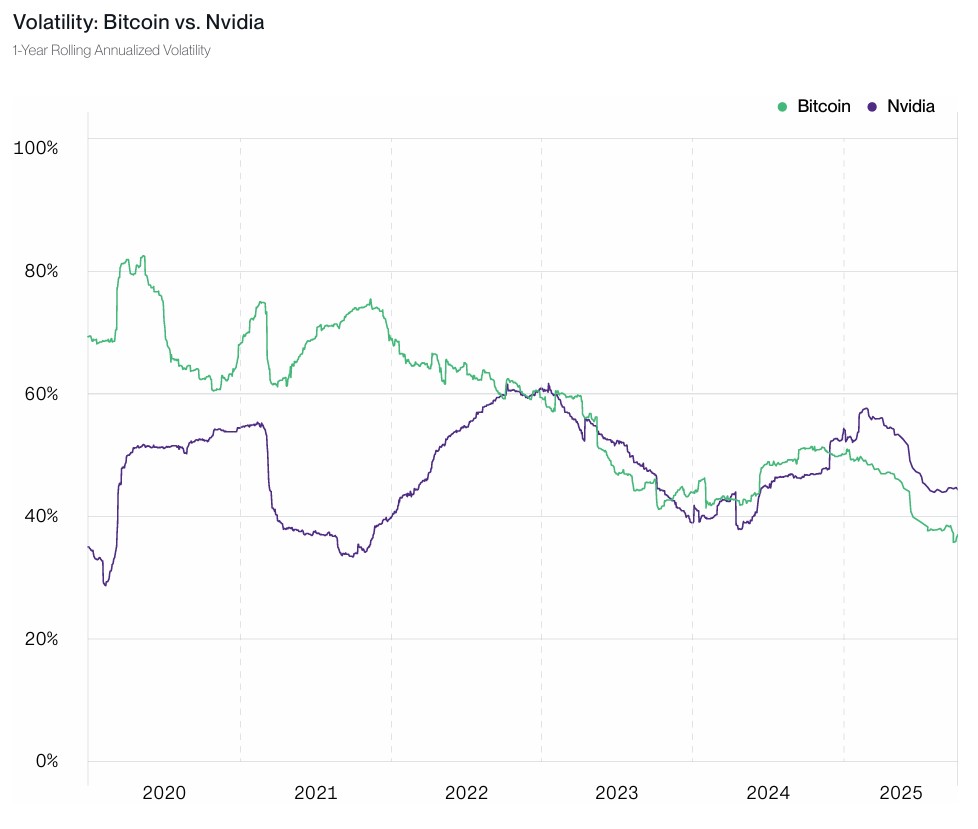 According to Bitwise, BTC will be less volatile than Nvidia next year. Source: Bitwise.
3. ETFs will absorb more than all of the new supply
Bitwise estimates that “ETFs will buy more than 100% of the new supply of bitcoin, ether (ETH), and solana (SOL) as institutional demand accelerates.” With a projected issuance of approximately 166,000 BTC By 2026, the firm emphasizes that “2026 will be the first year that most institutional investors will be able to access digital asset ETFs.” According to the company, this will generate «massive purchasing pressure.»
4. Superiority of stocks linked to bitcoin and cryptocurrencies
Bitwise’s report predicts that companies in the cryptocurrency sector will outperform the Nasdaq 100 in 2026. Following a period of regulatory clarity in Washington, Bitwise says this will «translate into new products, additional revenue streams, and M&A activity.» According to analysts at that investment manager, “digital asset stocks will do so well in 2026 that they will put Wall Street on the defensive.”
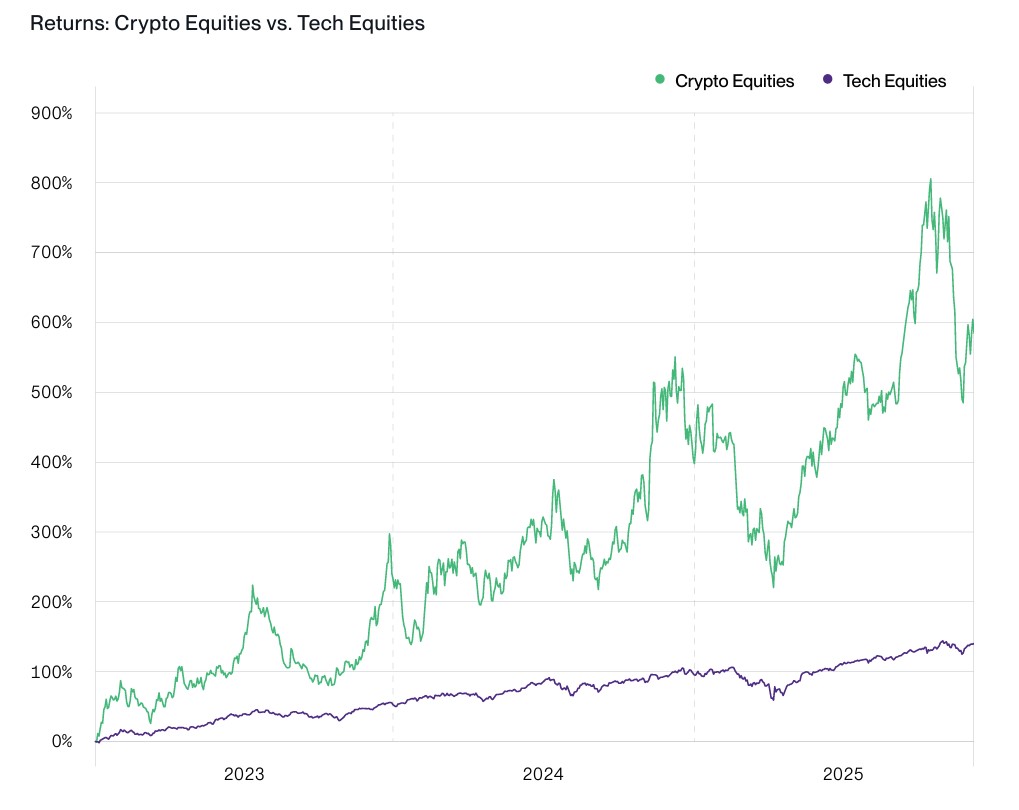 Shares of companies in the cryptocurrency sector will be more profitable than those of the Nasdaq 100, according to Bitwise. Source: Bitwise.
5. Polymarket and the post-election open interest record
Unlike those who believe that the prediction market depends exclusively on the presidential elections, Bitwise expects Polymarket to surpass its 2024 records next year.
The key lies in its expansion. This, remembering that the platform began to open to US users in early December 2025. In addition, they highlight that the company «recently secured an investment of $2 billion from Intercontinental Exchange (the parent company of the New York Stock Exchange).» Money that they will use to scale operations and new markets, suggests Bitwise.
6. Emerging currency crisis and the role of stablecoins
Stablecoins like USD Tether (USDT) and USD Coin (USDC) are reaching systemic size, with a market capitalization exceeding $300 billion. In this sense, Bitwise predicts that “stablecoins will be blamed for destabilizing the currency of an emerging market.”
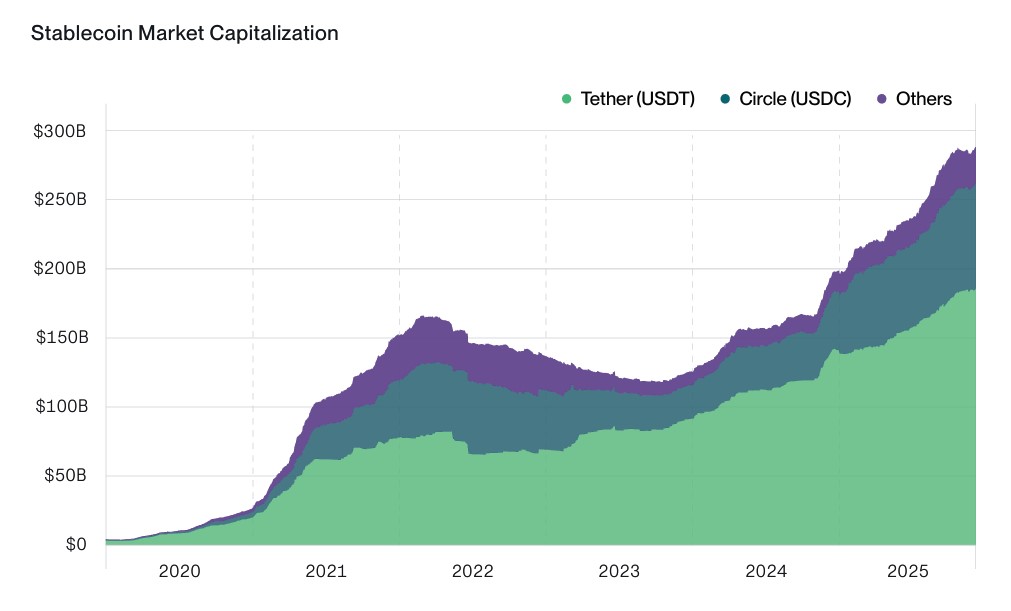 The market capitalization of stablecoins has grown significantly. Source: Bitwise. Bitwise explains that in countries with high inflation, such as Venezuela, these tools allow you to “easily save money in the relatively stable US dollar instead of your local currency.” Something that central banks interpret as a threat to their «monetary sovereignty.»
That, in fact, is argued by the International Monetary Fund (IMF). In a report published on December 4, the organization recognized that stablecoins are capable of taking space away from countries’ national currencies. Especially those in financial trouble, as reported by BitcoinDynamic.
7. Investment vaults as the new ETF 2.0
On-chain investment vaults will gain media relevance. Bitwise believes that a new wave of “high-quality curators will enter the market in 2026, attracting billions of dollars in capital.” What’s more, they predict that «one of the big financial publications – Bloomberg, The Wall Street Journal or the Financial Times – will label these vaults as ‘ETF 2.0’.»
8. Maximums for ETH and SOL under the protection of the CLARITY Law
Although they are bullish on ether (ETH) and solana (SOL) due to megatrends like tokenization, success depends on legislation. «If the CLARITY Act is passed, we believe it will spark a ‘face-melting’ bull run,» the report states. This is because that law would provide clear guidance on whether regulation falls to the Securities and Exchange Commission (SEC) or the Commodities and Futures Trading Commission (CFTC). Thus, eliminating the uncertainty that holds back large capital. According to Bitwise, the following chart shows the potential gains for ETH and SOL once the CLARITY Act is enacted.
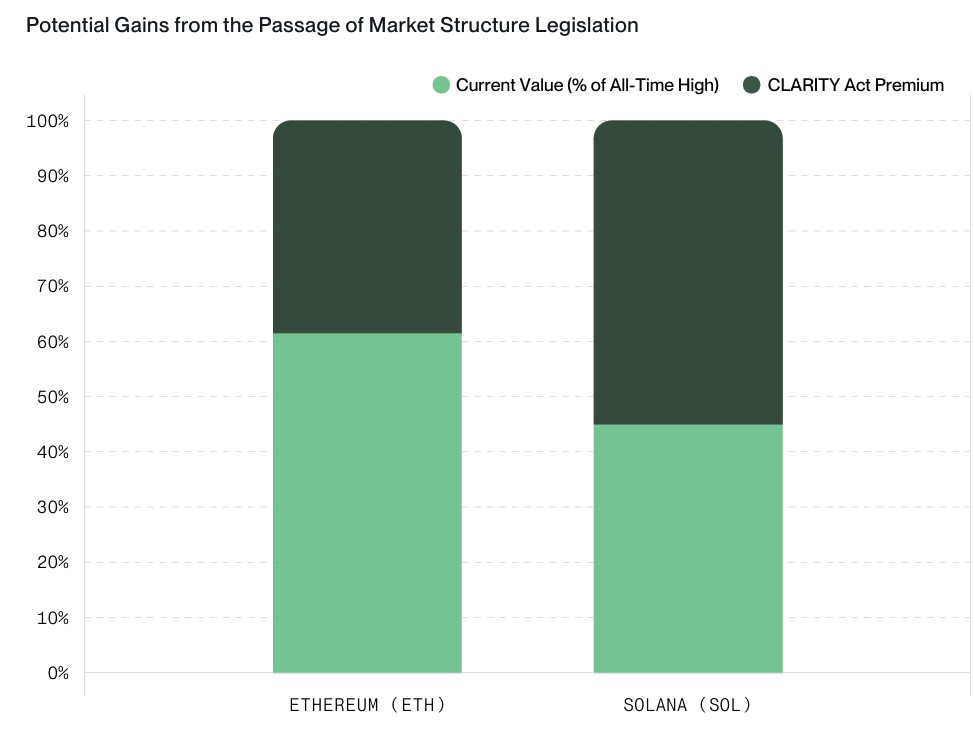 These are the potential gains for ETH and SOL once the CLARITY Law is established. Source: Bitwise.
9. The “Harvard effect” will benefit bitcoin
Adoption by university foundations will be key to the growth of bitcoin and cryptocurrencies. Bitwise highlights that these foundations are “trend pacesetters” and their massive entry into the digital asset market could bring “pension funds, insurance funds and other institutions to the table.”
10. The explosion of new financial products
Finally, the manager hopes that the market will be flooded with new investment options. Following the publication of general listing standards by the SEC in 2025, Bitwise predicts that “more than 100 ETFs linked to digital assets will be launched.”
And these, says Bitwise, will be of different types. That is, there will be spot cryptocurrency ETFs, staking, sector stock ETFs, and index ETFs.
A structural transformation
As the ecosystem heads towards 2026, the industry narrative undergoes a structural transformation. The possible break of bitcoin’s four-year cycle would not just be a change in the market cycle, but the reflection of a deep integration in the global macroeconomy.
However, this growth depends on critical external factors, such as the legal framework in the great powers. Ultimately, if these predictions come true, 2026 will mark the year that Bitcoin technology becomes a fundamental pillar of modern financial infrastructure.